Why Every Mala Has Exactly 108 Beads? Spiritual Meaning, History and Significance
📅 May 10, 2025 · ⏱ 4 min
post_top
Why Every Mala Has Exactly 108 Beads? Spiritual Meaning, History and Significance
Have you ever noticed that most traditional prayer malas contain exactly 108 beads? Whether you visit a Hindu temple, explore Buddhist meditation practices, or watch someone quietly chanting a mantra, you will often come across this sacred number.
But why 108? Why not 100, 50, or 110?
post_1
The number 108 is far more than a simple counting arrangement. In Hinduism, Buddhism, yoga, and other spiritual traditions, it carries deep symbolic significance. It is associated with spiritual completeness, cosmic harmony, meditation, and the journey towards inner awareness.
A mala with 108 beads is traditionally used to repeat a mantra 108 times, helping practitioners maintain focus and devotion during their spiritual practice.
In this article, we will explore why a mala has 108 beads, the spiritual meaning behind this number, its significance in ancient traditions, and how you can use a 108-bead mala in your daily meditation practice.
post_2
What Is a Mala?
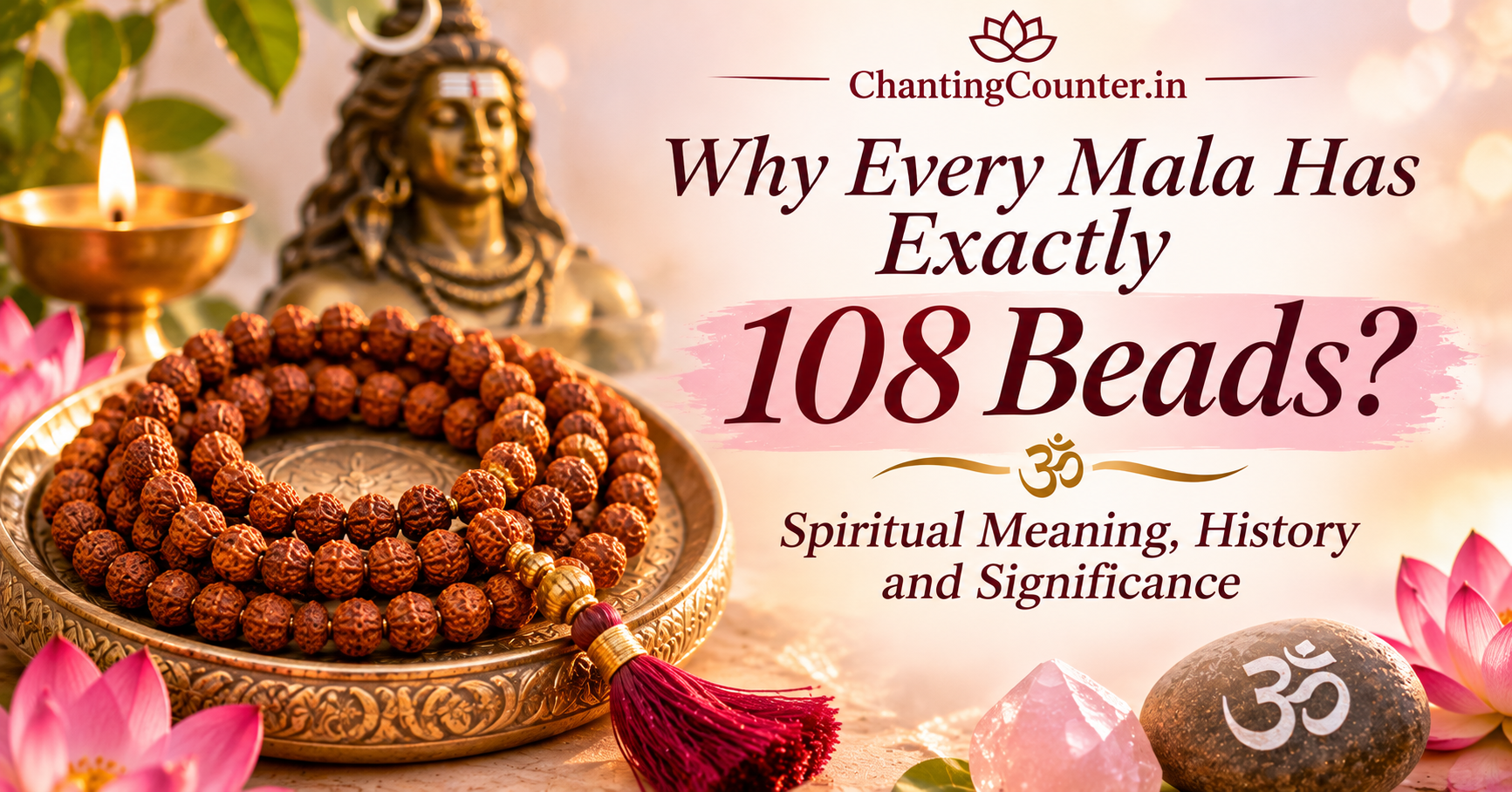
A mala is a traditional string of prayer or meditation beads used in Hinduism, Buddhism, and other spiritual practices. The Sanskrit word "mala" generally means a garland or wreath.
It is commonly used for japa, which means the repetition of a mantra, sacred name, or divine phrase.
During chanting, practitioners move one bead at a time while repeating their chosen mantra. This creates a simple rhythm that helps the mind remain focused instead of getting distracted by thoughts or external surroundings.
A traditional mala usually contains:
- 108 beads: Used for counting mantra repetitions.
- One guru bead: Also called the meru bead, it marks the beginning and end of a round.
- A tassel: Often attached below the guru bead, symbolizing different spiritual interpretations depending on the tradition.
Malas can be made from materials such as rudraksha seeds, tulsi wood, sandalwood, lotus seeds, and gemstones.
Why Does a Mala Have Exactly 108 Beads?
The number 108 holds a special place in several Indian spiritual traditions. Although there is no single universally accepted explanation for why malas contain 108 beads, different religious, philosophical, and symbolic interpretations explain its importance.
Here are some of the most widely known explanations.
1. The Spiritual Meaning of 108 in Hinduism
In Hindu traditions, 108 is considered a sacred and auspicious number. It appears in various religious practices, scriptures, rituals, and spiritual teachings.
One popular interpretation connects the number 108 with spiritual completeness and the relationship between the individual and the universe.
Chanting a mantra 108 times is traditionally believed to create a complete cycle of prayer or spiritual practice. Each bead represents one repetition, allowing practitioners to maintain consistency and devotion.
For many devotees, completing one round of a mala is not simply about reaching a number. It is about offering 108 repetitions with sincerity, concentration, and faith.
2. The Connection Between 108 and the 27 Nakshatras
Ancient Indian astrology recognizes 27 nakshatras, or lunar constellations, through which the Moon travels during its cycle.
Each nakshatra is traditionally divided into four padas, or quarters.
When we multiply these numbers:
27 Nakshatras × 4 Padas = 108
This creates a symbolic connection between the number 108 and the traditional Indian understanding of the cosmos.
Because of this association, 108 is often interpreted as a representation of cosmic completeness and the interconnectedness of the universe.
3. The 108 Upanishads
The Upanishads are ancient philosophical texts that explore profound questions about existence, consciousness, the self, and ultimate reality.
A traditional classification recognizes 108 Upanishads. These texts form an important part of Hindu philosophical and spiritual literature.
Their association with the number 108 further strengthens its importance in Hindu spiritual traditions.
For practitioners, chanting 108 times can therefore also represent a symbolic connection with the wisdom and teachings of ancient Indian philosophy.
4. The Connection Between 108 and the Sun and Earth
Another fascinating explanation comes from astronomy.
The average distance between the Earth and the Sun is approximately 108 times the Sun's diameter. Similarly, the average distance between the Earth and the Moon is approximately 108 times the Moon's diameter.
These are approximate astronomical relationships, not exact measurements. The actual ratios vary because planetary and lunar distances change over time.
Nevertheless, these numerical connections have inspired spiritual interpretations of 108 as a number that symbolizes the relationship between Earth, the Sun, and the Moon.
It is an interesting example of how ancient spiritual symbolism and observations of the natural world are often discussed together.
5. The 108 Defilements in Buddhist Traditions
The number 108 also has significance in Buddhism.
Some Buddhist traditions associate 108 with mental afflictions or defilements that create suffering and prevent individuals from experiencing clarity and liberation.
These are commonly connected with different combinations of sensory experiences, feelings, and attachments.
In certain Buddhist practices, 108 repetitions of prayers or mantras symbolize the aspiration to overcome ignorance, attachment, and other obstacles on the path towards enlightenment.
This is one reason why 108-bead malas are widely used in Buddhist meditation and chanting practices.
6. The 108 Marmas in Traditional Indian Knowledge
In traditional Indian knowledge systems, including Ayurveda and certain yoga-related traditions, the human body is described through energy points known as marma points.
A commonly recognized traditional classification identifies 107 major marma points. Some spiritual discussions connect the number 108 with these points and an additional symbolic center or principle.
However, interpretations differ across traditions, and this is not a universally established explanation for the 108 beads in a mala.
Why Is 108 Considered a Sacred Number in Yoga?
The number 108 is also deeply connected with yoga and meditation.
Many yoga communities organize special practices involving 108 Sun Salutations, particularly during seasonal transitions, celebrations, or spiritual gatherings.
For practitioners, completing 108 rounds of movement can represent dedication, discipline, transformation, and a symbolic new beginning.
Some yoga traditions also connect 108 with the relationship between the individual, the universe, and spiritual awareness.
Although the interpretations differ, the number continues to hold an important place in contemporary yoga and meditation communities.
What Is the Purpose of the Guru Bead?
If you look closely at a traditional 108-bead mala, you may notice one larger bead at the end. This is known as the guru bead or meru bead.
Unlike the other beads, the guru bead is not counted as part of the 108 mantra repetitions.
It serves as a marker indicating that you have completed one full round of chanting.
In many traditional practices, practitioners do not cross over the guru bead when beginning another round. Instead, they turn the mala around and continue chanting in the opposite direction.
The guru bead also carries symbolic meaning. It may represent the teacher, spiritual guidance, wisdom, or the connection between a student and their spiritual path.
How to Use a 108-Bead Mala for Chanting
Using a mala is simple, even if you are completely new to mantra meditation. You do not need to follow complicated rituals to begin a personal chanting practice.
Here is a simple step-by-step guide.
Step 1: Choose Your Mantra
Begin by choosing a mantra that feels meaningful to you. It can be a traditional Sanskrit mantra, a divine name, or a prayer from your spiritual tradition.
Some popular examples include:
- Om Namah Shivaya
- Hare Krishna Hare Krishna, Krishna Krishna Hare Hare, Hare Rama Hare Rama, Rama Rama Hare Hare
- Om Mani Padme Hum
- Om
- Gayatri Mantra
Step 2: Find a Quiet and Comfortable Place
Sit comfortably in a peaceful space where you can focus without unnecessary interruptions.
You can sit on a meditation cushion, a yoga mat, or a comfortable chair. Keep your back naturally upright and relax your shoulders.
Step 3: Hold Your Mala Correctly
Traditionally, the mala is held using the thumb and middle finger of the right hand in many Hindu japa practices. The index finger is often kept away from the beads.
However, customs can vary across spiritual traditions and lineages, so follow the instructions of your teacher if you practice within a particular tradition.
Step 4: Begin Chanting
Start with the bead next to the guru bead. Repeat your chosen mantra once and gently move to the next bead.
Continue this process until you have completed all 108 beads.
Try to focus on the sound, meaning, or feeling of the mantra instead of rushing through the repetitions.
Step 5: Complete One Full Round
Once you reach the guru bead again, you have completed one round of 108 repetitions.
If you wish to continue, turn the mala around rather than crossing over the guru bead, following the traditional practice.
Remember, the purpose of chanting is not simply to finish the count. It is to cultivate devotion, awareness, and a consistent spiritual routine.
How Many Mantras Are 1, 4, 8, and 16 Rounds of a Mala?
Since one traditional mala contains 108 beads, you can easily calculate the total number of mantra repetitions by multiplying 108 by the number of rounds.
- 1 round: 108 mantra repetitions
- 2 rounds: 216 mantra repetitions
- 4 rounds: 432 mantra repetitions
- 8 rounds: 864 mantra repetitions
- 16 rounds: 1,728 mantra repetitions
- 32 rounds: 3,456 mantra repetitions
For example, in the Gaudiya Vaishnava tradition, many practitioners follow a daily practice of chanting 16 rounds of the Hare Krishna maha-mantra. Since each round contains 108 repetitions, this adds up to 1,728 mantra repetitions.
You can use a traditional mala or a digital chanting counter to keep track of your daily rounds without losing concentration.
Why Do Some Malas Have 27 or 54 Beads?
Although 108-bead malas are the most widely recognized traditional form, you may also find malas with 27 or 54 beads.
These are often designed for convenience, shorter meditation sessions, or specific chanting practices.
- 108-bead mala: A traditional full mala used for one complete round of 108 repetitions.
- 54-bead mala: Contains half the number of beads in a traditional 108-bead mala. Two rounds complete 108 repetitions.
- 27-bead mala: Contains one-quarter of the traditional count. Four rounds complete 108 repetitions.
Smaller malas can be particularly convenient for people who prefer carrying their prayer beads while travelling or practising shorter chanting sessions.
Can You Use a Digital Chanting Counter Instead of a Mala?
Traditional malas have been used for centuries, but today many practitioners also use digital chanting counters to track their mantra repetitions.
A digital chanting counter offers a convenient way to maintain a consistent daily practice, especially if you follow a specific chanting goal.
Some advantages include:
- Easy counting: Track every mantra repetition without manually moving physical beads.
- Multiple rounds: Keep track of your daily chanting targets, including 4, 8, or 16 rounds.
- Convenience: Carry a compact counter while travelling or during your daily routine.
- Consistency: Monitor your chanting progress and build a regular spiritual habit.
- Focus: Spend more attention on your mantra rather than worrying about losing count.
A digital counter does not replace the spiritual significance of a traditional mala. Both are simply different tools that can support your chanting practice.
If you want to make your daily japa practice easier, explore the chanting resources and digital counting tools at ChantingCounter.in.
Recommended Products for Your Mala Chanting Practice
If you are beginning your mantra meditation journey or want to create a dedicated spiritual corner at home, a few simple accessories can make your practice more comfortable and organized.
- 108-Bead Rudraksha Mala: A traditional choice for many Hindu devotees, particularly those who practice Shiva-related mantra chanting.
- Tulsi Japa Mala: Commonly associated with Vaishnava traditions and devotional chanting, including Hare Krishna japa.
- Sandalwood Mala: A beautiful traditional option for prayer, meditation, and spiritual practice.
- Mala Storage Bag: Helps protect your prayer beads and keeps them organized when not in use.
- Meditation Cushion: Provides comfortable seating and helps you maintain a relaxed posture during longer chanting sessions.
- Digital Chanting Counter: A practical accessory for tracking daily mantra repetitions and completing your desired number of rounds.
- Spiritual Journal: Use a journal to record your daily chanting routine, reflections, gratitude, and personal intentions.
Choose accessories that suit your spiritual tradition, personal preferences, and daily routine. A meaningful practice does not require expensive products or elaborate arrangements.
Tips for Building a Consistent Mala Chanting Practice
Starting a chanting routine is easy. Maintaining it consistently is where the real discipline develops.
Here are a few simple suggestions to help you establish a sustainable practice.
- Start small: If 108 repetitions feel overwhelming, begin with a shorter session and gradually increase your practice.
- Choose a regular time: Morning and evening are popular times for meditation and chanting.
- Find a peaceful environment: Create a comfortable space where you can chant without frequent interruptions.
- Focus on the mantra: Pay attention to the sound and meaning instead of rushing to complete your rounds.
- Be patient with yourself: Your mind may wander. Gently bring your attention back to the mantra.
- Build consistency: A manageable daily routine is often easier to maintain than an ambitious target that feels exhausting.
Most importantly, remember that chanting is a personal spiritual practice. There is no need to compare your progress with someone else's.
Conclusion: 108 Beads Represent More Than Just a Number
So, why does a mala have exactly 108 beads?
The answer lies in a beautiful combination of religious traditions, spiritual symbolism, philosophical teachings, and interpretations of the natural universe.
From the 27 nakshatras and 108 Upanishads to Buddhist teachings and the traditional practice of mantra repetition, the number 108 has remained deeply meaningful across generations.
Each bead offers an opportunity to pause, repeat a sacred mantra, and gently bring your attention back to the present moment.
Whether you use a traditional rudraksha mala, a tulsi japa mala, or a digital chanting counter, what matters most is the sincerity and consistency you bring to your practice.
Sometimes, a simple act repeated 108 times can become a meaningful daily ritual — one that reminds you to slow down, reconnect with yourself, and make space for devotion and inner peace.
Frequently Asked Questions (FAQs)
1. Why are there exactly 108 beads in a Hindu mala?
A traditional Hindu mala contains 108 beads because 108 is considered a sacred and auspicious number in several Indian spiritual traditions. It is associated with the 27 nakshatras and their four padas, the 108 Upanishads, and the symbolism of spiritual completeness.
2. Does the guru bead count as one of the 108 beads?
No. In a traditional 108-bead japa mala, the guru bead is separate from the 108 counting beads. It marks the beginning and completion of a chanting round and is generally not counted as a mantra repetition.
3. What does chanting 108 times mean spiritually?
Chanting a mantra 108 times traditionally represents completing one full round of japa. Many practitioners associate it with spiritual discipline, devotion, concentration, and a symbolic sense of completeness.
4. Why do Hare Krishna devotees chant 16 rounds?
In the Gaudiya Vaishnava tradition, initiated practitioners commonly follow a daily commitment of 16 rounds of the Hare Krishna maha-mantra. Each round contains 108 repetitions, making a total of 1,728 mantra repetitions daily.
5. Can I use a 54-bead or 27-bead mala?
Yes. Smaller malas are commonly used in different chanting and meditation practices. You can complete 108 repetitions by chanting two rounds with a 54-bead mala or four rounds with a 27-bead mala.
6. Is it necessary to chant exactly 108 times every day?
No. The appropriate number of repetitions depends on your spiritual tradition, personal commitment, and practice. Although 108 is a traditional chanting count, beginners can start with a smaller and manageable number before gradually building consistency.
7. Can I use a digital chanting counter instead of a traditional mala?
Yes. A digital chanting counter is a convenient alternative for tracking mantra repetitions and daily rounds. A traditional mala and a digital counter can both support your practice. Choose whichever tool helps you maintain focus and consistency.
post_end